
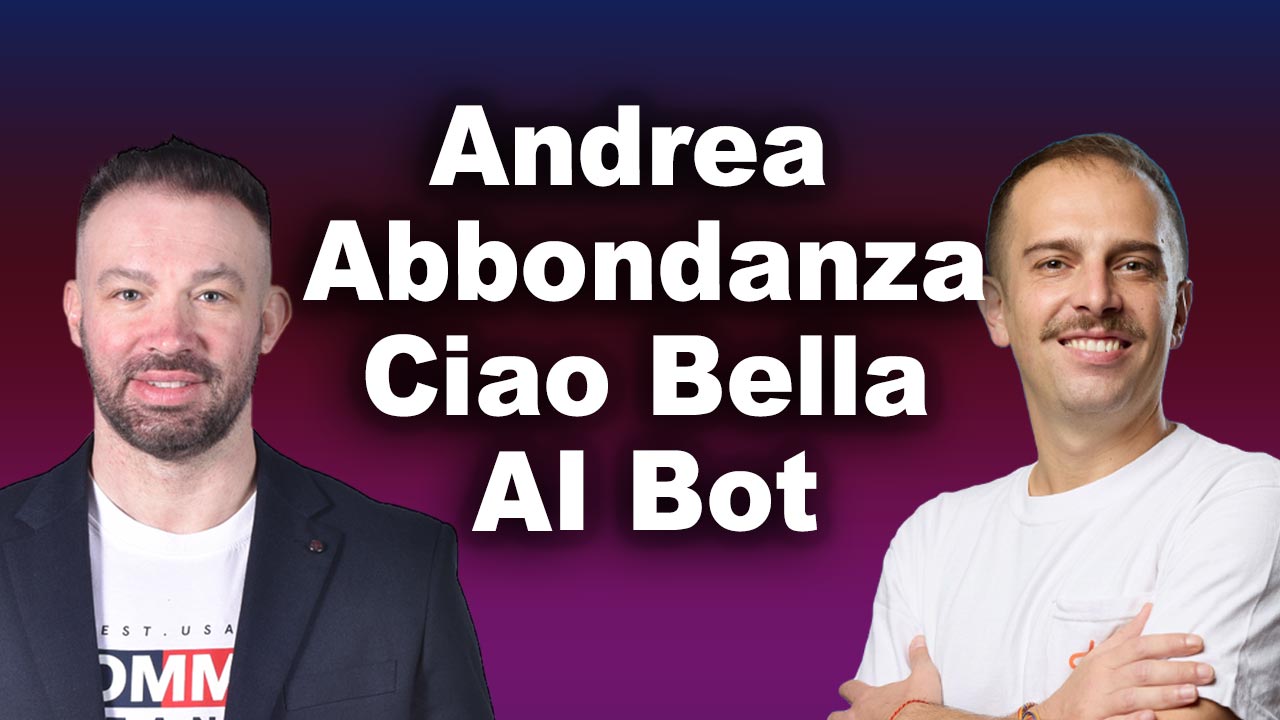
Andrea Abbondanza AI Automation Ciao Bella SEO For Restaurants
See more about Andrea Abbondanza:
Executive Summary
This conversation features an in-depth discussion between Yannis, an SEO agency representative, and Andrea Abbondanza, a digital entrepreneur with over 15 years of experience in SEO and digital marketing. The discussion centers on the rapid transformation of digital marketing driven by artificial intelligence (AI), the evolution of agency models, and Andrea’s approach to building AI-powered systems—particularly for the hospitality industry.
Andrea introduces himself as a seasoned entrepreneur with business operations spanning Europe, Australia, and expansion into the United States. Originally rooted in SEO, he has transitioned toward AI-driven solutions in response to the accelerating changes in the digital landscape. He emphasizes that traditional SEO and generalist digital marketing agencies are becoming obsolete or commoditized, increasingly competing on price rather than value. In contrast, specialization and efficiency—particularly through AI—represent the future of the industry.
A core theme of the conversation is the shift from human-driven operations to AI-augmented or AI-led systems. Andrea explains that many traditional agency workflows relied on a hybrid model: strategic teams based in higher-cost countries and execution teams outsourced to lower-cost regions. However, AI is now outperforming humans in many repetitive and structured tasks, not only reducing costs but also increasing accuracy and consistency. Tasks that can be standardized into clear procedures (SOPs) are especially well-suited for automation.
Despite AI’s strengths, Andrea highlights its limitations, particularly in strategy, client relationship management, and complex decision-making. He stresses that AI is not yet capable of fully replacing human judgment in these areas. One of the biggest technical challenges discussed is “hallucination,” where AI produces incorrect or fabricated outputs. Andrea explains that mitigating this issue requires structured system design, particularly around memory and task orchestration.
He outlines a framework for building effective AI systems:
- Master Prompt (Project “Bible”) – A foundational instruction set that defines the entire project. This ensures consistency and gives AI a persistent reference point.
- Agents – Specialized AI components assigned specific roles (e.g., SEO manager, content manager, social media manager).
- Orchestrator – A supervisory agent that coordinates all other agents, manages workflows, and ensures quality control.
- Memory Management – Persistent documentation (e.g., memory files and skill files) that allows the system to “remember” decisions and updates, addressing one of AI’s core weaknesses.
Through this multi-agent architecture, Andrea demonstrates how complex business processes can be automated while maintaining acceptable output quality. However, he acknowledges that human oversight remains essential, particularly to validate results and refine systems.
The conversation then shifts to Andrea’s niche business, SEO for Restaurants, which exemplifies his belief in specialization. Rather than targeting a broad market, he focuses exclusively on hospitality businesses, leveraging deep industry knowledge to deliver measurable results. His agency guarantees an average 40% increase in bookings within 12 months, achieved through a multi-channel strategy that includes SEO, Google Ads, website optimization, email marketing, and seasonal campaigns.
Andrea explains that restaurant marketing requires a holistic ecosystem approach.
Customer acquisition does not rely on a single channel but on the integration of multiple touchpoints. He highlights how most users search for restaurants: beginning with Google, reviewing menus, checking prices, and evaluating ratings and images before making decisions. This behavior informs his strategy, which prioritizes visibility across search engines, Google Business profiles, and increasingly, AI-driven platforms like large language models.
He also underscores the importance of operational readiness. Driving more traffic and bookings is only effective if the business can handle the increased demand and deliver a high-quality customer experience. Ultimately, marketing success must be supported by strong service delivery, as customer satisfaction leads to positive reviews and long-term growth.
Another major initiative discussed is Andrea’s AI product, “Ciao Bella.” This system represents a more advanced application of AI automation, combining branding, personalization, and functional utility. The concept includes a female avatar designed to resonate with restaurant owners and create a relatable, humanized interface for AI technology. Andrea emphasizes that personalization and storytelling are critical in making AI tools accessible and engaging for users.
The origin of the “Bella Ciao” branding is tied to Andrea’s cultural identity and personal experiences, illustrating how emotional and cultural elements can enhance technological adoption. He argues that as AI becomes more pervasive, humanizing technology through branding and narrative will be increasingly important.
The discussion also explores broader philosophical and strategic considerations. Andrea notes that while AI can replicate certain human sensory experiences (e.g., sight and sound), it cannot fully reproduce others such as taste, touch, smell, and emotional connection. This limitation suggests that businesses centered on human experience—such as hospitality—will remain resilient in an AI-driven world. He encourages entrepreneurs to focus on areas where human value cannot be easily replaced.
In terms of business development, Andrea distinguishes between lead generation and sales. His services focus on generating qualified leads, but converting those leads into customers requires a separate skill set. He points out that many businesses fail in digital marketing because they do not understand this distinction or lack an effective sales process. Trust-building is especially critical for online leads, as they do not come with the pre-established relationships found in traditional networks.
Andrea also discusses his broader business ecosystem, including a traditional digital agency and a newer AI-focused venture, “AI Tempo.” The latter aims to help companies implement advanced automation systems to improve efficiency and scalability. He is actively building an international team and positioning the brand globally through conferences and workshops.
In conclusion, the conversation highlights several key insights:
- The digital marketing industry is undergoing a fundamental transformation driven by AI.
- Efficiency, automation, and specialization are becoming critical competitive advantages.
- Multi-agent AI systems, when properly structured, can significantly enhance business operations.
- Human oversight, strategy, and emotional intelligence remain indispensable.
- Niche focus and deep industry understanding can drive superior results.
- Branding and personalization are essential for AI adoption.
- Businesses that emphasize human experience will retain long-term value.
Andrea’s perspective reflects a forward-looking approach that combines technical innovation with practical business strategy, positioning AI not as a replacement for humans, but as a powerful tool to augment and transform how businesses operate.
We’re live. Hello everyone!
This is Yannis from a SEO agency, and today I’m joined by Andrea Abbondanza. Did I pronounce that right?
Andrea: That’s right, Yannis.
You’re joining us from Bangkok, correct?
Andrea: Yes, I’m currently in Bangkok. I’ll be speaking at the Phuket Mastery Summit on April 3rd, where I’ll run a workshop on how to replace human departments with AI swarms.
That sounds a bit scary, honestly.
So let’s start with the basics: who is Andrea Abbondanza, and what do you do?
Andrea’s Background
Andrea: I’m a digital entrepreneur with multiple businesses across Europe—mainly Italy—and Australia, where I lived for ten years. We’re now expanding into the US market as well.
I have over 15 years of experience in SEO. I started as an SEO specialist, but recently I’ve shifted heavily toward AI, because things are changing very fast.
SEO as we’ve known it is evolving. The impact AI is having on businesses—especially digital marketing agencies—is massive. We need to adapt to this transformation.
In my opinion, generalist agencies will either disappear or be pushed into competing on price. Specialization, however, will remain valuable.
That’s why I created a brand called SEO for Restaurants. We specialize in digital marketing for hospitality businesses and guarantee, on average, a 40% increase in bookings within 12 months.
Why Restaurants?
I chose this niche not because it’s the most profitable or easiest—but because I’m Italian and I love food. Food is part of my culture, and I enjoy working closely with restaurant owners and experiencing their offerings.
Transition from SEO to AI
Yannis: How did you move from a traditional SEO agency into AI?
Andrea: It’s about efficiency and cost.
Traditionally, agencies had onshore teams and outsourced repetitive tasks to lower-cost regions. Now, AI is not only cost-effective—it’s more efficient.
AI can handle repetitive tasks better than humans, especially those defined by SOPs (Standard Operating Procedures). With proper setup, these tasks can be automated reliably.
However, strategy and client management still require humans—for now.
The Problem with AI Hallucinations
Yannis: I’ve experimented with AI tools myself, and hallucinations are a big issue. I even tried building a website with AI, and it burned €50 in a day—and still failed.
Andrea: That’s a common issue.
The solution starts with clear structure and memory management.
- The most important element is the first prompt (the “master prompt”).
- AI relies heavily on initial instructions but tends to “forget” over time.
- You need a structured system:
- A master prompt (project “bible”)
- Multiple agents (each with a specific role)
- An orchestrator (a supervisor agent managing everything)
Then comes memory management:
- Store instructions in structured documents (like memory files and skills files)
- Continuously update and reinforce them
Even then, AI may still hallucinate occasionally, so human supervision is still necessary.
Ciao Bella AI
Yannis: Tell us about your AI tool—Ciao Bella.
Andrea: Bella is a female avatar designed for restaurant owners. Since most restaurant owners are men, we created a relatable, engaging persona.
The name comes from a personal story. I was speaking at a conference in India, and a band started playing Bella Ciao. I jumped on stage and sang—it became a memorable moment.
That inspired the branding:
- Bella = the avatar
- Ciao = the booking system
It’s a mix of culture, storytelling, and technology.
Humanizing AI
AI adoption improves when it feels human.
People connect better with:
- Avatars
- Stories
- Personal branding
But AI still cannot fully replicate human experiences like taste, touch, emotions, and real connection. That’s where human-centered businesses will continue to thrive.
What Services Do You Offer Restaurants?
Andrea: First, I listen.
Then I analyze:
- Location
- Capacity
- Target audience
- Online presence (Google profile, website, reviews)
We optimize across multiple channels:
- SEO
- Google Ads
- Email marketing
- Seasonal campaigns (Valentine’s, Christmas, etc.)
- Social media for awareness
Most importantly, we focus on the entire ecosystem, not just one channel.
How People Choose Restaurants
I always ask clients:
“How would you find a restaurant in a new city?”
Most people:
- Search on Google
- Check reviews, photos, and menus
- Compare prices
That’s why visibility and trust are critical.
Leads vs Sales
Yannis: Can you help other businesses grow leads too?
Andrea: Yes—but I focus on leads, not sales.
I bring traffic and potential customers. The business must:
- Deliver a great experience
- Build trust
- Convert leads into customers
Leads from the internet are different from referrals—you must build trust from scratch.
Other Businesses
I also run:
- A traditional digital agency in Italy
- An AI-focused company called AI Tempo
We have a team of developers and AI specialists, and we’re expanding internationally with workshops and speaking engagements.
Final Thoughts
Yannis: How can people contact you?
Andrea:
- Search “SEO for Restaurants” on Google
- Connect with me on LinkedIn
- Visit my website (AI Tempo)
- Email or message me directly
Yannis: Andrea, it was a pleasure. Hopefully we’ll see you in Greece soon.
Andrea: Definitely—I’d love to come back!
Thank you everyone for watching!
Follow us on social media and visit our website if you want to grow your business with SEO or AI.
Request an SEO Quote Today!
You can subscribe to our newsletter if you want to learn more about us and get on the first page of Google.

I am Yannis Divramis, I am an SEO Expert. I have been doing SEO since 2013.
I run the Divramis SEO Agency, and I am very glad that you’ve watched this video and keep watching the other videos, because we are posting many videos about SEO every month.
We are specialized in Escorts Agency SEO, adult SEO, Roofers SEO and many other verticals.
So, if you run a website and want to rank higher in Google, you can ask now for a website promotion offer and get a quote from us.
Ask now for a website promotion offer
See more post about SEO:
- Best CTR Manipulation Tool In 2026: Is Scaleranings.com Worth It?
- Whats the top strategy to get on chatgpt Anni Ma odys.click
- Triple your income from the internet with SEO
- How to remove review on google and safeguard your business reputation
- Boost Your Reputation with a google review link: Quick Setup Guide