
Did ChatGPT Build Its Own Search Index? Inside Labrador
Hello folks! Did ChatGPT build its own search index? For two years most of us in SEO believed a simple story: ChatGPT does not have an index of its own, it just borrows results from Bing and Google. Then Tomek Rudzki from Peec AI published an investigation in September 2026, and the story changed. I have been doing SEO since 2013 with my Best SEO Agency team, and this investigation is big news for anyone who cares about AI search.
So let me explain what they found when they watched ChatGPT build its own search index, in plain words, and what it means for your website. As always, I will not invent anything. Every fact below comes from the Peec AI article by Tomek Rudzki, from his own summary on X, and from my own posts. When something is my opinion, I tell you.
Did ChatGPT Build Its Own Search Index?
Yes. According to Peec AI, ChatGPT runs its own retrieval index, which OpenAI calls Labrador internally. And it is not one index. It is a whole family of indexes, one for each type of content. Tomek wrote it very clearly: the assumption that ChatGPT retrieves only through Bing and Google is wrong.
That is the short answer to the question did ChatGPT build its own search index. The long answer is more interesting, because it shows how ChatGPT finds, stores and ranks the pages it shows to millions of people. And if you want your business to appear in ChatGPT, you need to understand both.
On X, Tomek summed it up like this: we heavily underestimate ChatGPT, one of the biggest players in this field, reducing its impact to they use Google, they use Bing. I agree with him. Most SEOs still think about ChatGPT as a small window on top of Google. It is becoming much more than that.
In short:
- Did ChatGPT build its own search index? Yes, it is called Labrador.
- It is a family of twelve vertical indexes, from web and news to shopping and medical.
- It caches pages, and it still uses Google, Bing and other providers.
- To see ChatGPT build its own search index in action, look at shopping.
- You can test which of your pages it stored with lockdown mode.
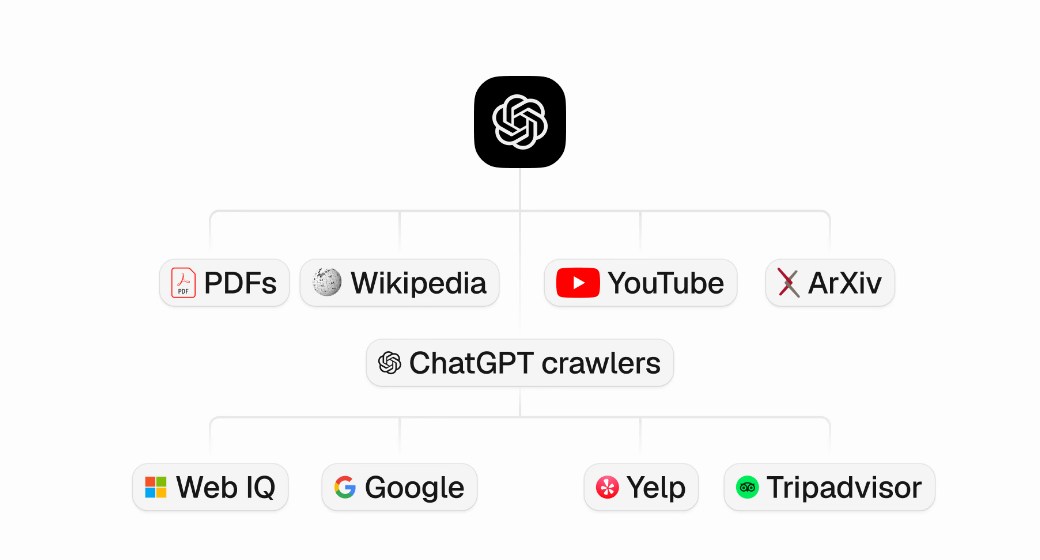
What this diagram shows
This is the diagram Peec AI put at the top of the article, and it explains the whole story in one picture. Let me walk you through it, from top to bottom, because it is the best map I have seen of how OpenAI let ChatGPT build its own search index.
- At the top is ChatGPT. Everything below feeds the answers you read in the chat.
- The first row shows PDFs, Wikipedia, YouTube and arXiv. These are four of the content types that Peec AI found with their own place inside Labrador, the family of indexes ChatGPT uses.
- In the middle are the ChatGPT crawlers. Peec AI lists the ChatGPT crawler as a source of its own, running independently of any external search engine.
- The bottom row shows Web IQ, Google, Yelp and Tripadvisor. These are four of the outside providers that, according to Peec AI, still feed ChatGPT: the Microsoft Web IQ grounding platform, Google data, and the Yelp and TripAdvisor listings.
So when you ask did ChatGPT build its own search index, the diagram gives you the honest answer: yes, with its own crawlers and its own vertical indexes, but it still borrows from Google, Microsoft and review platforms. Both halves of the picture matter for your SEO, now that we have watched ChatGPT build its own search index in public.
What Is Labrador, The Index Behind ChatGPT?
Labrador is the name of the retrieval system ChatGPT uses, according to the Peec AI investigation. When people ask why did ChatGPT build its own search index the way Google did, the answer starts here, because Labrador looks a lot like the structure Google spent two decades building: a general web index plus specialised vertical indexes on top.
The twelve Labrador indexes
Peec AI found these categories inside Labrador:
- General web
- YouTube
- News, with separate tiers for the last day, the last seven days and everything older
- arXiv
- Wikipedia
- Local
- Finance, including a separate index for finance PDFs
- Legal
- Medical
- Shopping
- Images
Most of these indexes were never documented anywhere before, as Tomek wrote on X. Think about that for a second. If you run a law firm, a clinic, a shop or a local business, there may be a ChatGPT index made especially for your type of content.
What Labrador stores
According to Peec AI, the Labrador index stores the same kind of data other indexes like Google store, including the full page content, the crawl date and the publication date. In other words, the dates on your pages matter, and the full text of your pages is kept, not only a short snippet. That detail alone shows how seriously OpenAI took the job when it let ChatGPT build its own search index.
How Do We Know: Did ChatGPT Build Its Own Search Index Or Not?
Good question. You should never believe a big claim without evidence, and I like this investigation because it shows three kinds of evidence. Let me take them one by one, because together they answer how we know ChatGPT did build its own search index.
The result_source field
For two months, between 21 May and 21 July 2026, a field called result_source appeared directly in the server-sent events (SSE) of ChatGPT. Server-sent events are the live stream of data the ChatGPT servers send to your browser while an answer is being generated. That field only ever carried four values: Labrador, Bright, Oxylabs and SERP. Three of them are external scraping providers. The first one, Labrador, is OpenAI’s own index. That field is the simplest proof: for two months, each result showed whether it came from OpenAI’s own Labrador index or from one of the three outside providers.
OpenAI job postings
The second piece of evidence comes from OpenAI job postings. Peec AI quotes a Software Engineer, Foundations Search posting that asks for someone skilled in designing and operating indexing systems, retrieval pipelines and serving layers.
An Engineering Manager, Online Data Systems posting describes a team that builds and operates the core online database and indexing services behind OpenAI production apps, ChatGPT included, running at multi-region, multi-cloud, exabyte scale. An exabyte is 10 to the power of 18 bytes. As Peec AI says, that is not the scale you build for a system that just passes queries through someone else’s index. Why would OpenAI hire for exabyte-scale indexing unless it wanted to let ChatGPT build its own search index?
A third posting, for embedding retrieval, talks about designing new embedding training objectives, scalable vector store architectures and dynamic indexing methods, across dense, sparse and hybrid representations.
The antitrust testimony
The third piece of evidence comes from a courtroom. During the Google antitrust trial, Nick Turley, the head of ChatGPT, testified under oath. Peec AI reports that he said OpenAI had significant quality issues with the search data coming from non-Google API partners, that OpenAI wanted to work with Google, and that Google refused. That is why OpenAI needed a plan B, and the plan B was to let ChatGPT build its own search index in-house.
Why Did ChatGPT Build Its Own Search Index?
Here is the business logic, and as a man with a degree in Finance and Accounting, I find it fascinating. If you depend on a competitor for your most important raw material, you are never free. Google refused to supply its data, and the other providers had quality problems. So the only way forward was to let ChatGPT build its own search index.
According to Peec AI, Turley said OpenAI began building its own search index in 2023, aiming to answer 80% of queries from it by the end of that same year. That was an extremely aggressive timeline. In the same testimony, Turley also said that even with full access to Google index data, it would take OpenAI at least five years just to find out whether answering 100% of queries from its own index is even possible.
So the strategy, as Peec AI describes it, has been the same from the start: use external providers like Google to get off the ground, then rely more and more on your own index every year. Full independence is not something you switch on. It is a slow shift, tested one query type at a time.
That is the real reason behind the question why did ChatGPT build its own search index. Not for fun, not as a side project. It was a deliberate, years-long build, and the job postings show it is still growing.
Timeline: How Did ChatGPT Build Its Own Search Index?
A timeline makes everything clearer, so here are the dates that the sources give us. Read it slowly, because it shows that the decision to let ChatGPT build its own search index was taken years before most SEOs noticed.
- 2023: according to the testimony of Nick Turley, as reported by Peec AI, OpenAI began building its own search index, with the aim of answering 80% of queries from it by the end of that year.
- The Google antitrust trial: Turley testified that OpenAI had significant quality issues with search data from non-Google API partners, that OpenAI wanted to work with Google and that Google refused.
- 21 May to 21 July 2026: the
result_sourcefield appeared in the ChatGPT server-sent events (SSE), with the values Labrador, Bright, Oxylabs and SERP. - Mid-August 2026: Tomek Rudzki spotted the A/B test prefer-index-over-serp-v3 affecting 8% of chats.
- 2 September 2026: at least five shopping experiments were still running.
- Beginning of September 2026: the one billion page test website of Metehan Yesilyurt had 6 million pages crawled by ChatGPT, at 35,000 requests per hour.
- 4 September 2026: Peec AI published the article ChatGPT built its own search index.
So when somebody asks you when did ChatGPT build its own search index, the honest answer is: it started in 2023, and it is still being built today. Peec AI says the system is being rebuilt week to week.
One small note about the dates. The Peec AI article places the testimony in an antitrust hearing in one heading, while Tomek wrote on X that it was a 2025 US antitrust hearing. I will not choose between them. What matters is what Turley said under oath, and both sources agree on that.
How Does ChatGPT Rank Pages In Its Own Index?
Now we come to the part every SEO wants to know: ranking. Once you see ChatGPT build its own search index, the next question is how it orders the results. Peec AI does not claim to know the full ranking formula, and neither do I. But the evidence shows the building blocks.
Sparse plus dense retrieval
Sparse representation is the language of TF-IDF and BM25, the lexical ranking Google itself was built on. Dense representation means embeddings, the vector search that understands meaning. Peec AI explains that if you combine the two, you get exactly the setup you need to run Reciprocal Rank Fusion, or RRF, to merge the two result lists. Metehan Yesilyurt, a Peec AI GEO researcher, documented that mechanism first.
What does that mean in simple words? Your page needs the right words, so the lexical part finds it, and the right meaning, so the vector part finds it. Keywords are not dead. They just are not alone anymore, now that we have seen ChatGPT build its own search index on top of both methods.
The shopping ranking stack
For one shopping A/B test, named shopping-reduced-topn-v4b, Peec AI saw the ranking stack in the same events:
- BM25 lexical component: narrows the field down to 10 sources for ranking.
- rerank400: reranks a pool of 400 candidates.
- prod400: 400 products used as the input pool.
- ann4096: approximate nearest neighbour, meaning vector search, run at two different dimensions, 12,288 and 4,096.
Ten sources. Read that again. If BM25 narrows the field to ten sources, then being in the first ten matters inside ChatGPT exactly as it matters on the first page of Google.
ChatGPT Shopping: Where You Can See ChatGPT Build Its Own Search Index
If you want to see ChatGPT build its own search index in real time, Peec AI says to look at shopping. In mid-August 2026, Tomek spotted an A/B test named prefer-index-over-serp-v3 affecting 8% of chats. Put plainly, OpenAI has built a product index and is testing it on traffic slices ranging from single digits up to 20%.
As of 2 September 2026, at least five separate shopping experiments were still running:
- prefer-index-over-serp-v3
- chatgpt-shopping-noamazon
- shopping-index-q2qb
- shopping-hqi-v2
- shopping-hq-v1
Peec AI confirmed that prefer-index-over-serp-v3 and shopping-index-q2qb both run on ChatGPT’s own index. Whether hqi stands for high quality index is not confirmed. Five live production experiments, all testing variations of the index against real shopping traffic, point to a team actively building a product index and checking whether it is ready to rely on. Shopping is where we can watch ChatGPT build its own search index one experiment at a time.
If you run an eshop, this is the part to watch, because the same product pages you optimise for Google are now judged by a second index. See our ecommerce SEO and Shopify SEO pages for the basics.
Does ChatGPT Cache Pages Instead Of Fetching Them Live?
Yes, according to Peec AI. Live retrieval is too slow to run on every query. Peec AI cites the HTTP Archive Almanac: 58% of pages take longer than 0.8 seconds to load. Waiting for that, and dealing with server errors, is not possible at ChatGPT scale. Page speed matters for a cache too, so read our technical SEO page if your site is slow.
The one billion page experiment
Metehan Yesilyurt published a test website with one billion pages, just to see how much of it ChatGPT would crawl. As of the beginning of September 2026, ChatGPT had crawled 6 million of those pages, and it was still going, at a rate of 35,000 requests per hour. As Peec AI says, crawling that aggressively only makes sense if the pages are going somewhere: a cache, or an index being built from it. This is what it looks like when you see ChatGPT build its own search index from the crawler side.
The lockdown mode test
To confirm the cache, Peec AI used ChatGPT lockdown mode, which cannot browse live pages but can still return offline or cached results. They asked for the latest version of the homepage of several major SEO publishers, including Search Engine Journal, Search Engine Land and Search Engine Roundtable. ChatGPT was not fetching those pages live. It served them from its own cache. A cache like this is one more sign of how far OpenAI went to let ChatGPT build its own search index and serve answers fast.
Does ChatGPT Still Use Google And Bing?
Yes, and this is important, because some people will now jump to the opposite mistake. Did ChatGPT build its own search index and drop Google? No. It built the index, but it has not replaced classic search.
Malte Landwehr, the CPO of Peec AI, ran a clean test. He picked a website with zero organic traffic and, on specific days, asked only ChatGPT about it. On those days, Google Search Console showed a traffic spike for that exact site. That is direct evidence that ChatGPT still queries Google while grounding its answers, even after OpenAI let ChatGPT build its own search index.
Bing and Microsoft Web IQ
Bing shows up too, mainly in Deep Research, as Peec AI GEO researcher David Konitzny flagged on LinkedIn. And Microsoft’s own Web IQ grounding platform, which advertises sub-165ms P95 latency and token-efficient retrieval, names ChatGPT directly among the products it already powers, alongside Copilot and enterprise clients like Nasdaq. So did ChatGPT build its own search index and stop using Microsoft? No, Microsoft is still in the mix.
Which Outside Providers Feed ChatGPT?
Even after OpenAI let ChatGPT build its own search index, it still borrows data. On top of its own crawler, ChatGPT is stitching together at least eight outside providers, according to Peec AI:
- Its own crawler, running independently of any external search engine.
- Bright, very likely Bright Data, which scrapes Google web results and separately scrapes Google Maps for local listings.
- Oxylabs, which scrapes Google and feeds the news vertical.
- A third SERP-scraping channel, tagged simply serp, also serving news, plus a separate mixed local-results version.
- Yelp.
- TripAdvisor.
- Two anonymous internal pipes, tagged b1 and b3. b1 surfaces business websites and Facebook pages, and b3 routes to Google Maps.
- Web IQ, the Microsoft grounding platform, which Microsoft says already powers ChatGPT.
Peec AI calls this a smart strategy, and I agree. Combine your own crawler with ranking signals borrowed from many outside sources, fold it all into one index, and you get the upside of every source without spending twenty years building it like Google did. That is the clever part of how OpenAI let ChatGPT build its own search index: it did not start from zero.
What Should SEOs Do Now That We Saw ChatGPT Build Its Own Search Index?
Here are the practical lessons from the Peec AI article, and then I will add my own.
- Stop assuming Bing visibility is a proxy for ChatGPT visibility. Peec AI says the overlap is lower than most people think, and what looks like Bing may actually be routed through Microsoft Web IQ.
- If you sell products, watch the ChatGPT shopping results. That is where the index push is most visible today.
- If local listings matter for your business, get them right on Yelp and TripAdvisor first. They are treated as licensed partners, and Google Maps data reaches ChatGPT anyway, just without you having any say in how it is sourced.
- Check ChatGPT lockdown mode to see if ChatGPT already cached your most important pages.
Peec AI also warns that the system is being rebuilt week to week, so some details may already look different. That is honest, and it is the nature of watching an index get built in public.
For local businesses, I would add one thing from my own work: your Google Business Profile and your citation sources still matter. Peec AI found that Bright scrapes Google Maps and that the b3 pipe routes to Google Maps, so your Maps data travels into ChatGPT whether you manage it or not. Better to manage it.
Did ChatGPT Build Its Own Search Index For Your Type Of Business?
Here is where it gets practical. Peec AI found twelve vertical indexes inside Labrador. Nobody outside OpenAI knows exactly how each one ranks, and I will not pretend to know. But the simple fact that these indexes exist tells every type of business where to look. Seeing ChatGPT build its own search index with separate verticals is like seeing Google launch News, Images and Maps years ago. Each vertical becomes its own small battlefield.
Did ChatGPT build its own search index for online shops?
Yes, there is a shopping index. Shopping is the vertical where you can watch ChatGPT build its own search index most clearly, with five live experiments as of 2 September 2026. If you sell online, your product pages, your product names and your descriptions must be clear and complete, because a product index needs clean product data to work with. One of the experiment names, chatgpt-shopping-noamazon, also shows that OpenAI is testing results with and without Amazon. Every online shop, every clothing store, electronics store or jewelry store should keep an eye on this.
Did ChatGPT build its own search index for local businesses?
Yes, Peec AI lists a local index. There is a local index inside Labrador, and Peec AI found that Yelp, TripAdvisor and Google Maps data all reach ChatGPT. For a restaurant, a plumber, a roofer or a dental clinic, that means your listings now work for two systems at once. Now that we have seen ChatGPT build its own search index for local results this way, the local listings you ignored for years suddenly feed an AI assistant.
Did ChatGPT build its own search index for news and blogs?
Yes, a news index with three time tiers. The news index has separate tiers for the last day, the last seven days and everything older. Labrador also stores the publication date of every page. If you publish news, fresh dates and clear publication dates matter. When you watch ChatGPT build its own search index with time tiers like these, freshness is clearly part of the design. If you run a blog, keep your evergreen posts updated, because a stored publication date tells the system how old your content is.
Did ChatGPT build its own search index for law firms?
Yes. Peec AI lists a legal index. For a law firm or a criminal defense lawyer, it means legal content may be retrieved from a dedicated pool, separate from general web pages. Clear practice pages, accurate legal explanations and real attorney profiles are the kind of content worth having in that pool.
Did ChatGPT build its own search index for healthcare?
Yes. There is a medical index too. A healthcare provider, an urgent care center or a mental health practice should make sure its condition and service pages are accurate, reviewed by real clinicians and easy to read. As we watch ChatGPT build its own search index for medical topics, quality and trust are the obvious filters to expect.
Did ChatGPT build its own search index for finance?
Yes. The finance vertical even has a separate index for finance PDFs. If you are a financial advisor, an accounting firm or an insurance agency, your PDFs, reports and documents may be stored and retrieved on their own. Make sure they have clear titles and text that can be read.
Did ChatGPT build its own search index for video?
Yes, for YouTube. There is a YouTube index. We post videos about SEO every month on our channel, and this finding makes video titles and descriptions even more important. If you make videos, see my notes on YouTube video SEO. Watching ChatGPT build its own search index for YouTube tells you that your video data can become part of AI answers, not only part of YouTube search.
Did ChatGPT build its own search index for research and B2B?
Yes, more than one. arXiv, Wikipedia and PDF indexes complete the picture. For B2B companies and software companies that publish whitepapers, research and documentation, those vertical pools are where serious, technical content can live. Publish your best research in a form that can be read and cited.
How To Check If ChatGPT Cached Your Pages
Now that you have seen ChatGPT build its own search index and cache pages, here is the simplest test you can run today, based on the method Peec AI used:
- Open ChatGPT and enable lockdown mode in your settings. In lockdown mode, ChatGPT cannot browse live pages, but it can return offline or cached results.
- Ask ChatGPT to show you the latest version of your homepage, the same way Peec AI asked about the SEO publishers.
- Repeat it for your most important money pages, the pages that bring you clients.
- Write down which pages come back and which do not, and check again after you publish new content.
If your money pages do not come back at all, that is a signal to work on them: better content, better internal links, faster pages and more mentions around the web.
How Did ChatGPT Build Its Own Search Index Inside? What We Still Do Not Know
I promised you no invented facts, so here is the honest list of open questions. The sources do not answer them, and anyone who claims to know is guessing.
- The full ranking formula. We can see BM25, rerankers and vector search in the shopping stack, but not the weights or the other signals.
- What hqi means. Peec AI says it is not confirmed whether hqi stands for high quality index.
- How often the cache refreshes. We know ChatGPT serves cached pages, but the sources do not say how often a cached page is updated.
- Whether 100% is even possible. Turley himself said it would take at least five years just to find out.
- How stable any of this is. Peec AI warns that the system is being rebuilt week to week.
So treat every detail as a snapshot. The big picture is solid: we know that ChatGPT did build an index of its own, and the questions that remain are about how it works inside. Watch the next findings from Peec AI and the SEO community, and test things on your own site, because to see ChatGPT build its own search index in public is something we never had with Google in its early years.
My Take: Did ChatGPT Build Its Own Search Index To Replace Google?
Did ChatGPT build its own search index to replace Google tomorrow? Not yet. And maybe never fully. Even Nick Turley said it would take at least five years just to know if 100% is possible. But the direction is clear.
I have a personal story about how fragile our tools are. In September 2026 I flew to Shenzhen for the Shenzhen SEO conference, and behind the Great Firewall nothing worked: no Google, no Gmail, no YouTube, no ChatGPT. I told the whole story in why I escaped China and never went to the conference, and the secret point was simple: China is not for everyone. But the same trip shows how fragile it is to depend on one platform. That is exactly why OpenAI did not want to depend on Google, and why it chose to let ChatGPT build its own search index. It is also a good reason not to depend only on Google yourself.
In my interview with Anni Ma, published as the top strategy to get on ChatGPT, I described a technique we call LLMs feeding: writing posts about your brand on other websites, long format and full of money keywords, so the models learn who you are and what you do. I also wrote there that GBP citations are a must if you run a local business. Now that we have seen ChatGPT build its own search index, with a crawler that reads full pages and stores them, those mentions have a place to live.
And the old rules still apply. In 2019, coming back from the Chiang Mai SEO conference, my fifth lesson was that backlinks are still the number one ranking factor on Google. I also believe in unique, evergreen content published every month. A system that stores the full content of your pages, with the crawl date and the publication date, rewards exactly that: real content, kept fresh. I love optimal minimalism and quality over quantity, as Aristotle used to say.
So do not panic, and do not chase every new tool. Build your site like a Toyota, reliable and made to last. Then make sure ChatGPT can find it, cache it and trust it. Simple, but not easy!
Frequently Asked Questions: Did ChatGPT Build Its Own Search Index?
So, did ChatGPT build its own search index or not?
Yes. According to Peec AI, ChatGPT runs its own retrieval index called Labrador, which is a family of vertical indexes for web, PDF, YouTube, news, arXiv, Wikipedia, local, finance, legal, medical, shopping and images.
When did ChatGPT start to build its own search index?
Peec AI reports that, according to the testimony of Nick Turley, OpenAI began building its own search index in 2023. So the effort to let ChatGPT build its own search index is several years old.
Why did ChatGPT build its own search index?
Turley testified that OpenAI had significant quality issues with search data from non-Google API partners and that Google refused to work with them, so OpenAI chose to let ChatGPT build its own search index in-house.
What is the name of the index ChatGPT built?
Labrador. That is the internal name Peec AI found in the result_source field, next to the external providers Bright, Oxylabs and SERP.
Did ChatGPT build its own search index for shopping?
Yes. In mid-August 2026 the test prefer-index-over-serp-v3 affected 8% of chats, and as of 2 September 2026 at least five shopping experiments were running. Shopping is where you can see ChatGPT build its own search index most clearly.
Did ChatGPT build its own search index for local search?
Yes, Peec AI lists a local index, and local data also arrives from Yelp, TripAdvisor and Google Maps through outside providers.
Does ChatGPT still use Google and Bing?
Yes. Peec AI found direct evidence that ChatGPT still queries Google, Bing appears mainly in Deep Research, and Microsoft says its Web IQ platform already powers ChatGPT.
Does ChatGPT cache web pages?
Yes. In a lockdown mode test, ChatGPT served the homepages of major SEO publishers from its own cache instead of fetching them live.
Did ChatGPT build its own search index to replace Google?
Not yet. Turley said it would take at least five years just to find out whether answering 100% of queries from its own index is possible. For now, ChatGPT combines its own index with outside providers.
How does ChatGPT rank pages in its index?
The full formula is not public. In one shopping test, Peec AI saw a BM25 lexical step that narrows the field to 10 sources, a reranker over 400 candidates and vector search, so both words and meaning matter.
How can I check if ChatGPT stored my pages?
Enable lockdown mode in your ChatGPT settings and ask for the latest version of your homepage and your money pages, the same method Peec AI used with the SEO publishers.
Will Bing visibility get me into ChatGPT?
Not necessarily. Peec AI advises you to stop assuming Bing visibility is a proxy for ChatGPT visibility, because the overlap is lower than most people think.
How can I show up in the ChatGPT index?
Keep your pages fast, unique and up to date, get your local listings right on Yelp, TripAdvisor and Google Maps, earn mentions on other websites, and check lockdown mode to see which of your pages ChatGPT already cached.
What should I do first now that we have seen ChatGPT build its own search index?
Run the lockdown mode test on your five most important pages this week. It costs nothing, and it shows you where you stand before you change anything.
More From My Blog On AI Search And SEO
Now that we have watched ChatGPT build its own search index, AI search is no longer a side topic. These posts and pages on my site will help you go deeper.
AI Search And Generative Engine Optimisation
Read about generative engine optimisation, ranking first in ChatGPT, AI first search, how to win in Google AI search, whether your site is ready for AI search, rank or die by 2026, SEO in 2026, AI SEO keyword research, AI web design and 10 critical AI SEO mistakes.
Interviews And Conferences
Some of the best lessons come from people in the field: AI automation with Martin Atrin, Craig Campbell on SEO in 2026, Kalin and SEO domains, Steven Khanna on SEO income, Mads Singers and the SEO Mastery Summit, Chiang Mai SEO conference 2025, Chiang Mai SEO conference 2019, Shenzhen SEO 2026 day one, SEO Athens Summit 2025 and SEO testing with Kyle Roof.
Links, Mentions And Entities
Mentions on other websites feed both Google and ChatGPT, and they matter even more once you see ChatGPT build its own search index from crawled pages. See why links are still the most important ranking factor, link earning versus link building, Google entity stacking, my aged domains review, why people are afraid of backlinks and our link building services.
Content That Gets Stored And Cited
If ChatGPT stores the full content of your pages, the content must be worth storing. Watching ChatGPT build its own search index makes that very clear. Read why content is king, three basic tips for evergreen results, content pruning, how to write great pillar articles, money keywords and the marketing funnel, the four pillars of SEO and SEO copywriting.
Technical Foundations
A cache likes fast, clean pages, and fast pages help when you want ChatGPT to store them. Check our SEO site audit, on-page optimisation, mobile optimisation, responsive websites, search engine friendly URLs and the checklist before a website launch.
Google Updates
Google is not going anywhere, and ChatGPT still uses it. Stay current with the Google September 2026 spam update, Google core updates, the August 2025 spam update and what to do if your site disappeared from Google.
Local And Reputation
Yelp, TripAdvisor and Google Maps all reach ChatGPT, so your reputation travels. Local businesses felt it first when we saw ChatGPT build its own search index with a local vertical. Read about a Google review link, removing a review on Google, building online reputation and local search for small businesses.
Learning SEO
And if you are just starting: the best way to learn SEO yourself, how to rank your site on Google, 11 reasons to do SEO, 7 lethal misconceptions about SEO, my three main SEO principles and in-house SEO versus an SEO agency.
Sources And Further Reading
- Peec AI: ChatGPT built its own search index, by Tomek Rudzki
- Tomek Rudzki on X: ChatGPT runs its own index
- Edward Sturm on YouTube: ChatGPT is building its own search index
Book a Discovery Call Today!
Do you want to double your income and clients?
Book a Discovery Call Today!

I am Yannis Divramis, I am an SEO Expert. I have been doing SEO since 2013.
I run the Divramis SEO Agency, and I am very glad that you’ve watched this video and keep watching the other videos, because we are posting many videos about SEO every month.
So, if you run a website and want to rank higher in Google, you can ask now for a website promotion offer and get a quote from us.
Ask now for a website promotion offer
See more about SEO:
- 11 digital marketing tips
- Money from SEO
- Triple your income from the internet with SEO
- Programmatic SEO
- How to optimize for voice search