

Google September 2026 Spam Update: Timeline And What To Do
Hello folks! The Google September 2026 spam update is the hottest topic in the SEO community right now. The forums are full of complaints about falling traffic. I have been doing SEO since 2013 with my Best SEO Agency team, and I have seen many Google updates come and go. So let me tell you what really happened, step by step, with the official facts first and my own opinion after.
Before reading further, one small promise. I will not invent anything in this post. Every date and every number below comes from Google itself, from Barry Schwartz at Search Engine Roundtable and from Matt G. Southern at Search Engine Journal. When something is my personal opinion, I say so.
What Is The Google September 2026 Spam Update?
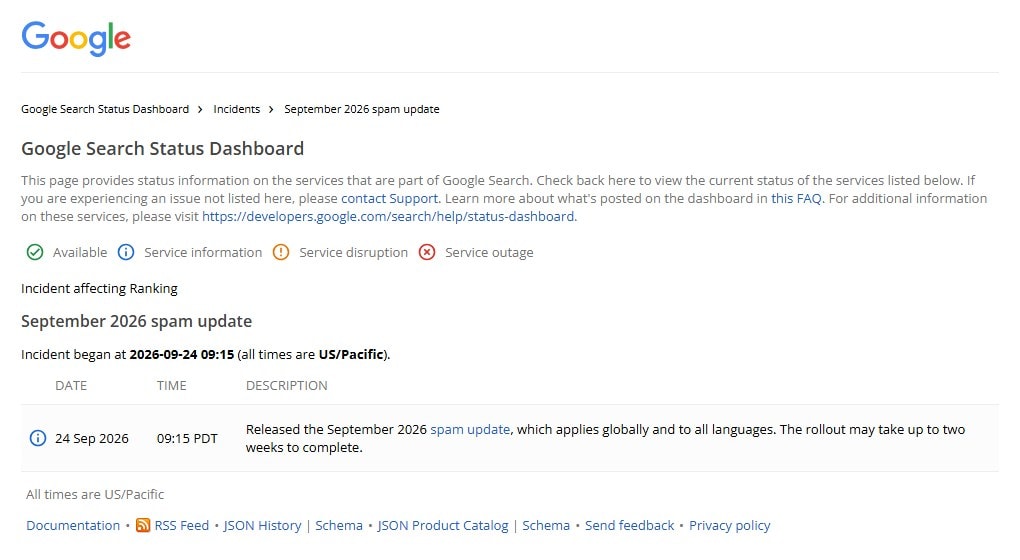
The Google September 2026 spam update is an official improvement to the automated systems Google uses to detect spam in search results. Google released it on 24 September 2026 at 09:15 Pacific time, and the Google Search Status Dashboard says it applies globally and to all languages. In plain words: every site, in every country, in every language.
The official note is only two lines long. It says the rollout may take up to two weeks to complete. That is all. No list of targets, no examples, no explanation. Google did not add anything else, so the real story comes from the people who track rankings every single day.
Here is the official dashboard entry, word for word: Released the September 2026 spam update, which applies globally and to all languages. The rollout may take up to two weeks to complete. You can read it yourself on the Google Search Status Dashboard. On 7 October 2026 the dashboard still showed only that first entry. On 8 October 2026, at 01:37 Pacific time, Google added the second and final entry: The rollout was complete as of October 8, 2026.
Why Is The Google September 2026 Spam Update Different?
Do you think a spam update is a quick hit and run? Usually it is. This one is not. According to Search Engine Journal, the Google September 2026 spam update is the fourth confirmed spam update of 2026, after the updates in March, June and August.
Look at how long the previous three took to roll out:
- The March 2026 spam update took 19 hours and 30 minutes.
- The June 2026 spam update took 2 days and 1 hour.
- The August 2026 spam update took 2 days and 16 hours.
Google gave each of those a rollout window of a few days. For the Google September 2026 spam update, Google said it may take up to two weeks. Barry Schwartz wrote that Google told him the Google September 2026 spam update is different from the previous three exactly because of that longer rollout, around two weeks instead of the typical two days.
In other words, the Google September 2026 spam update is slower, longer and harder to read than the spam updates before it. What does a longer rollout mean for you? It means more than one wave. Instead of one bad day, sites can see an impact on two or three days, then calm, then another impact a few days later. That is exactly what happened with the Google September 2026 spam update.
Google September 2026 Spam Update Timeline, Day By Day
Barry Schwartz followed the Google September 2026 spam update closely on Search Engine Roundtable. Here is the timeline he reported, wave by wave:
- 24 September: Google announces the update on the status dashboard.
- 25 to 27 September: the first wave. Most likely the first sites were hit on these days.
- 30 September to 1 October: things cooled a bit, then heated back up. Barry calls this the second wave.
- 4 to 6 October: a third spike in volatility. On 6 October Barry wrote that he believes this is the final phase and that the update should be done any day now.
- 8 October: Google confirms on the status dashboard that the rollout was complete as of October 8, 2026.
Glenn Gabe, another respected SEO, wrote on X on 1 October that he believes the Google September 2026 spam update made a specific change on 30 September. He said several site owners emailed him about a huge drop right on that day.
So if your traffic fell on one of these dates, the timing alone is not proof, but it is a strong clue. Write the dates down. You will need them in Search Console later.
What Did Rank Tracking Tools Show?
Search Engine Roundtable collects data from fourteen rank tracking tools: AccuRanker, Algoroo, AWR, CognitiveSEO, DataForSEO, Mangools, Mozcast, Semrush, Serpstat, SimilarWeb, Sistrix, Wincher, Wireboard and Zutrix. During the Google September 2026 spam update, Barry published their charts and noted that some tools did not update every day, but most of them did.

The aggregate volatility on his chart jumped from the low thirties before the announcement to the fifties and sixties in the days after 24 September. I like these tools, but bear in mind one thing. A tool measures the weather of the whole sky. It does not tell you if rain fell on your own garden. Only your own data can do that.
What Does The Google September 2026 Spam Update Target?
Here is the honest answer: Google did not say. Search Engine Journal reported that Google has not said whether the Google September 2026 spam update targets a specific spam policy or tactic. Anyone who tells you exactly what this update targets is guessing.
What we do know is the rule book. Google publishes its spam policies, and Google says that sites that violate them may rank lower in results or not appear in results at all. Google also says it detects violations through automated systems and, as needed, human review that can result in a manual action.
So the smart move with the Google September 2026 spam update is not to guess the target. The smart move is to check your site against every policy, one by one. Let us do that together.
Google Spam Policies To Check After The Google September 2026 Spam Update
These are the spam policies listed on the official Google spam policies page, explained in simple words. If the Google September 2026 spam update hurt your site, start here.
- Cloaking: showing one thing to Google and another thing to people, to manipulate rankings.
- Doorway abuse: creating many sites or pages to rank for similar searches, which send users to pages that are not as useful as the final destination.
- Expired domain abuse: buying an expired domain and reusing it mainly to manipulate rankings with content of little or no value.
- Hacked content: content placed on your site without your permission through a security hole.
- Hidden text and link abuse: text or links placed only for search engines, such as white text on a white background.
- Keyword stuffing: filling a page with keywords or numbers, often in lists or out of context.
- Link spam: links created mainly to manipulate rankings, including buying or selling links for ranking purposes.
- Machine-generated traffic: sending automated queries to Google without permission.
- Malicious practices: malware and other practices that deceive users or put their security at risk.
- Misleading functionality: sites that promise a service or content they do not actually provide.
- Scaled content abuse: many pages made mainly to manipulate rankings rather than help users, no matter how the content is created.
- Scraping: taking content from other sites and republishing it without adding original value.
- Site reputation policy: third party content hosted on a strong site mainly to borrow the ranking signals of that host.
- Sneaky redirects: sending visitors to a different URL than they asked for, to show different or unexpected content.
- Thin affiliation: affiliate pages that copy the merchant descriptions without original content or added value.
- User-generated spam: spammy content that users add through comments, forums or open accounts, often without the owner noticing.
Notice something? Most of these policies are about one thing: trying to trick Google instead of helping people. In my post on three basic SEO tips for evergreen results I wrote that copied content can be harmful for your ranking in the long run. This list proves the point again, and the Google September 2026 spam update is one more reminder.
Some of these problems are technical, like hacked content, hidden text and sneaky redirects. They belong to technical SEO, and if you are moving pages, read how to handle a redesign without losing your SEO. Others live inside your content and your keywords, like keyword stuffing and scaled content abuse, where on-page optimisation and honest keyword research help. Thin affiliation matters if you earn from affiliate marketing. And link spam is about your backlinks, a topic I covered in link earning versus link building and in my post on nofollow links.
Who Got Hit By The Google September 2026 Spam Update?
Google does not publish a list of sites affected by the Google September 2026 spam update, so here I can only share what site owners reported in public. Please read these as reports, not as official facts.
On Search Engine Roundtable and WebmasterWorld, people wrote that their Google Discover and Google News traffic vanished around 30 September, and that Discover was extremely volatile, doing well for half a day and then practically dead. One news publisher wrote that the earnings of their news site were down 80 percent. Another site owner wrote that search and Discover traffic plummeted, and that the readers who remained were coming from China instead of their own country.
Some people were angry about the results themselves. One forum member wrote that Google News was filled with cheap AI translations with broken grammar. Glenn Gabe noticed that Reddit pages with AI translations were surging again during the Google September 2026 spam update in Italy, Germany, Brazil and France, after they had dropped with the May 2026 core update and the June 2026 spam update. He also reminded everyone that Google has said AI translation is fine if the content is high quality.
My opinion? Every update has winners and losers, and the losers always write louder than the winners. That is human. But when you see so many complaints about AI translations, keep it in mind for your own site. Quality is not a slogan. It is the price of staying on the first page.
How Do I Know If The Google September 2026 Spam Update Hit My Site?
Last year, in my post about the Google August spam update 2025, I gave three checks. They work again for the Google September 2026 spam update:
- Search Console trends. Look at impressions, clicks and average position, and mark the official start date, 24 September 2026, plus the wave dates above.
- Query and page patterns. Look for groups of pages or groups of queries that moved together, not just one URL.
- Competitor movement. Compare with your nearby competitors, so you can separate a problem on your site from a change in your whole industry.
Search Engine Journal gives the same advice: if you see changes in rankings or traffic during the rollout, check your Search Console data and consider the timing.
One more check that many people forget: the Manual actions report in Search Console. Google says a manual action is issued when a human reviewer at Google decides that pages on a site do not comply with its spam policies, and that affected sites are notified in the Manual actions report and in the Search Console message center. An algorithmic drop and a manual action are two different problems, so check this report before anything else.
If you need a second pair of eyes, our SEO site audit and our organic search audit can help with this check.
What Should You Do If The Google September 2026 Spam Update Hit Your Site?
Here is my first rule, and I have a whole video titled Dont do anything till Google update rolls out 100%. I said the same thing in 2025: you should not do anything until the update is complete and the volatility has settled down. Changing your site in the middle of a rollout is like changing tyres while the car is still moving. You will never know what helped and what hurt.
Google confirmed that the Google September 2026 spam update was complete on 8 October 2026, so now is the time to follow these steps:
- Read the spam policies again and be honest with yourself. Did you buy links? Did you publish hundreds of thin pages? Did you rent out part of your site to third parties?
- Fix the cause, not the symptom. Remove or improve thin and scraped pages, clean up spammy user comments and fix any hacked content.
- Clean your link profile. Links bought only for rankings are link spam under Google policies. I explained how I watch new links in smart strategies for identifying and controlling fresh links. If you need help with clean links, see our link building services.
- Be patient. Google says changes may help a site improve if its automated systems learn over a period of months that the site complies with its spam policies. Months, not days. Recovery from the Google September 2026 spam update will not happen overnight.
Patience is the hardest part. I know. But SEO is a marathon, not a sprint, and spam updates remind us of that every single time.
Did the Google September 2026 spam update hit your site? Talk to an SEO consultant before you change anything.
What If Your Site Gained Rankings?
Congratulations! But do not celebrate too much. If competitors who used spam dropped and you moved up, that is great news and a good sign for your work. Use this moment to publish more useful content and earn more quality links, because there will be another update.
The rollout is over, so check your Search Console again around 15 October 2026, one week after Google confirmed that the Google September 2026 spam update was complete.
My Take: Spam Updates Reward The Patient And The Honest
Let me tell you how I see it, as an SEO who started with a 20 euro IKEA desk and an old PC with Windows XP. I always wanted my SEO work to be reliable like a Toyota, built to last for years, not for one season. A spam update like the Google September 2026 spam update is the moment when you find out if your rankings were built like a Toyota or like a cheap rental car.
Back in 2019, after the Chiang Mai SEO conference, I wrote that backlinks are still the number one ranking factor on Google. But the key word is quality. Link spam is on the Google list for a reason, and one good link from a real site is worth more than a hundred links from a link farm. Quality over quantity, as Aristotle used to say.
I also believe in unique, evergreen content, published every month. Not ten thousand pages made in one night to manipulate Google. Scaled content abuse is right there on the policy list, and it does not matter how the content is created. Write for people first, and Google will follow. I wrote in 2019 that content is king, and every spam update since then has made that post more true, not less.
Google has fought spam for a very long time. On this blog you can read about the Penguin algorithm, the difference between white hat and black hat SEO and the Google ranking factors. The names of the updates change. The lesson stays the same.
So do not panic about the Google September 2026 spam update. Do not buy a magic fix. Check your data now that the rollout has finished, fix what is really broken and keep building. Simple, but not easy!
Frequently Asked Questions About The Google September 2026 Spam Update
When did the Google September 2026 spam update start?
Google released it on 24 September 2026 at 09:15 Pacific time, according to the Google Search Status Dashboard.
How long does the Google September 2026 spam update take?
Google said the rollout may take up to two weeks. Barry Schwartz reported waves on 25 to 27 September, 30 September to 1 October, and 4 to 6 October, and Google confirmed the rollout was complete on 8 October 2026.
Does the Google September 2026 spam update affect every country?
Yes. Google says it applies globally and to all languages.
What does the Google September 2026 spam update target?
Google has not said. Check your site against all the Google spam policies listed above.
Should I change my site during the Google September 2026 spam update?
Not while it is rolling out. Google confirmed the rollout was complete on 8 October 2026, so now check your data and fix what is really broken.
How fast can a site recover?
Google says improvement may come if its automated systems learn over a period of months that the site complies with its spam policies.
More From My Blog On Google Updates And SEO
One spam update is only one chapter of a long story. If you want to understand why the Google September 2026 spam update hits some sites and not others, these posts on my blog will help you see the bigger picture.
Google Algorithm Updates
Read about the EMD exact match domain update, the Google BERT update and the effects of the Google Pigeon update.
Ranking Factors
Ranking factors change slowly, spam rules change faster, as the Google September 2026 spam update shows. Start with 15 SEO ranking factors, then go deeper with the 200 ranking factors revisited series, part one and part two.
Links And Backlinks
Links are where many spam problems start, and link spam is one of the Google spam policies to check after the Google September 2026 spam update. Read why people are afraid of backlinks and whether exact match anchor text helps or hurts.
Content And Keywords
Good content is the best protection against any spam update, including the Google September 2026 spam update. See money keywords and the marketing funnel and how to write great pillar articles.
Technical SEO And Site Health
A healthy site recovers faster. Check the 11 most common SEO mistakes and why mobile optimisation matters.
AI Search
AI search is the other big topic of 2026, next to the Google September 2026 spam update. Read how to rank first in ChatGPT and AI first search.
Learning SEO
If you are new to SEO, start with the best way to learn SEO yourself and how to start with SEO.
Reputation And Local SEO
Spam is not only on your site. It can also hit your name. Read about ranking first on Google Maps and a Google review link.
Working With An SEO Agency
And if you are thinking about getting help, read how much SEO costs and in-house SEO expert versus SEO agency.
Sources And Further Reading
- Google Search Status Dashboard: September 2026 spam update
- Search Engine Roundtable: final phase of the September 2026 spam update
- Search Engine Roundtable: the second wave on 30 September
- Search Engine Journal: Google rolls out the September 2026 spam update
- Google Search Central: spam policies for Google web search
- Edward Sturm on YouTube: Google September 2026 spam update video
Book a Discovery Call Today!
Do you want to double your income and clients?
Book a Discovery Call Today!
I am Yannis Divramis, I am an SEO Expert. I have been doing SEO since 2013.
I run the Divramis SEO Agency, and I am very glad that you’ve watched this video and keep watching the other videos, because we are posting many videos about SEO every month.
So, if you run a website and want to rank higher in Google, you can ask now for a website promotion offer and get a quote from us.
Ask now for a website promotion offer
See more about SEO:
- Google core updates: how to avoid falling in the search engines
- My site disappeared from Google, now what?
- How to destroy your site
- Why links are still the most important ranking factor
- Content pruning